
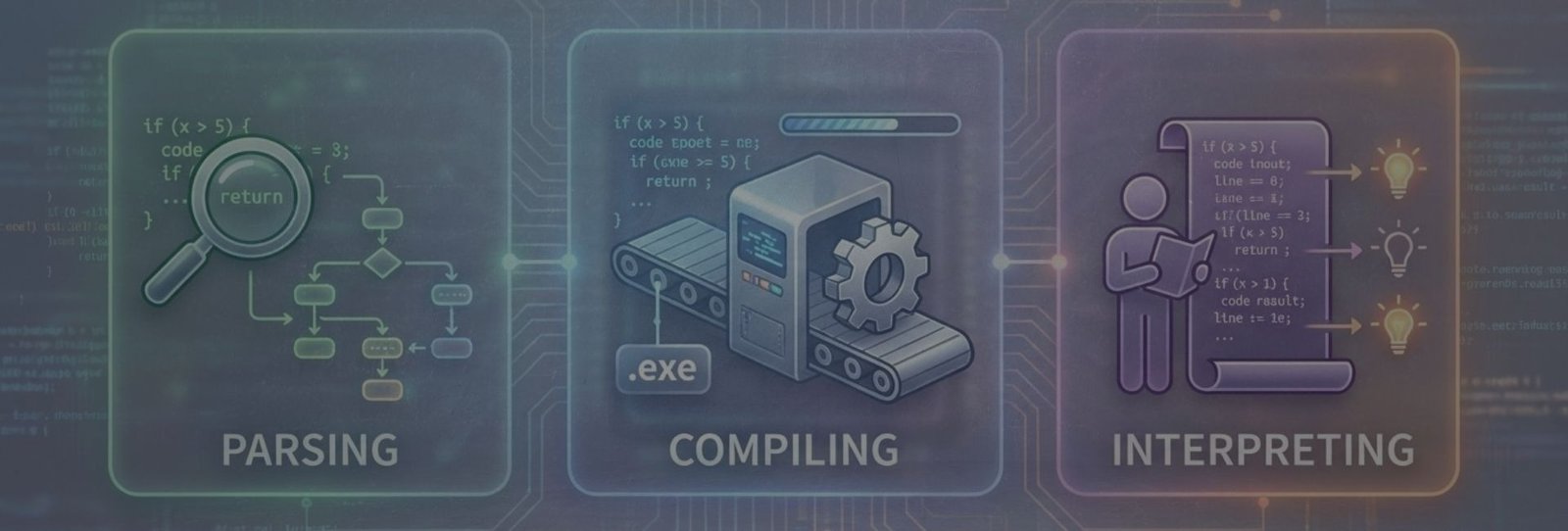

What is Parsing?
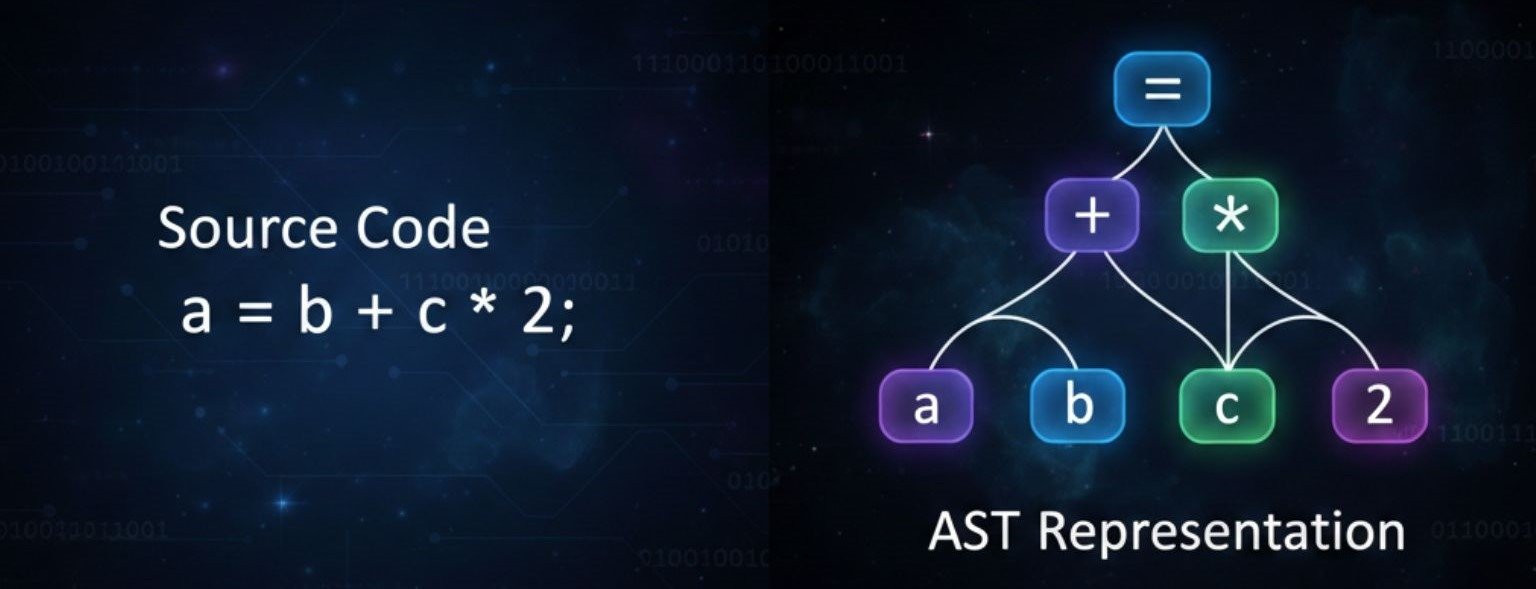
Parsing is the process of analyzing the structure of source code to check syntax and build a structure (AST). AST (Abstract Syntax Tree) is a tree-like data structure that represents the logical structure of source code after parsing. AST = Structured representation of code. It removes unnecessary details (like brackets and semicolons) and keeps meaningful syntax.
if x > 5:
    print(x)
# ✔ Syntax is correct → parsed successfully
# ❌ Missing : → parsing errorWhy AST is called Abstract?
Because it does not store every symbol exactly as written — only what matters for understanding and execution.
For your example a = b + c * 2, the parser follows the Order of Operations (Multiplication before Addition): The Root (=): The assignment happens last. The Left Branch: The variable a where the result will be stored. The Right Branch (+): The sum of b and the result of the multiplication. The Leaf Nodes: The values c and 2 are multiplied first.
What is Compiling?
Compiling converts the entire program into machine code or bytecode before execution. Errors shown before running.
int x = 10;
//Machine code / executableWhat is Interpreting?
Interpreting executes code line-by-line at runtime without creating a separate executable. Errors occur during execution.
print("Hello")
print(y)
# Hello
# NameError: y not defined|
Language |
Parsed |
Compiled |
Interpreted |
Parsing Type |
Execution Speed |
|---|---|---|---|---|---|
|
C |
Yes |
Yes |
No |
Static, Top-down |
Very Fast |
|
C++ |
Yes |
Yes |
No |
Static, Top-down |
Very Fast |
|
Java |
Yes |
Yes (Bytecode) |
Yes (JVM) |
Static |
Fast |
|
Python |
Yes |
Yes (Bytecode) |
Yes |
Dynamic |
Slow |
|
JavaScript |
Yes |
JIT (Just-In-Time) |
Yes |
Dynamic |
Medium–Fast |
|
C# |
Yes |
Yes (IL) |
Yes (.NET CLR) |
Static |
Fast |
|
Go |
Yes |
Yes |
No |
Static |
Very Fast |
|
Rust |
Yes |
Yes |
No |
Static |
Very Fast |
|
Ruby |
Yes |
No |
Yes |
Dynamic |
Slow |
|
PHP |
Yes |
No |
Yes |
Dynamic |
Slow–Medium |
|
Swift |
Yes |
Yes |
No |
Static |
Fast |
|
Kotlin |
Yes |
Yes |
Yes (JVM) |
Static |
Fast |
|
R |
Yes |
No |
Yes |
Dynamic |
Slow |
|
MATLAB |
Yes |
No |
Yes |
Dynamic |
Slow |
|
Assembly |
No |
Yes |
No |
None |
Fastest |
|
HTML |
Yes |
No |
No |
Declarative |
N/A |
|
CSS |
Yes |
No |
No |
Declarative |
N/A |
|
SQL |
Yes |
No |
Yes (DB Engine) |
Declarative |
Fast (Engine-based) |
- JIT
JIT (Just-In-Time) Compilation is a technique where code is compiled at runtime, just before it is executed, instead of being fully compiled in advance.
JIT = Compile while running
It combines the benefits of compilers (speed) and interpreters (flexibility).
- .NET CLR
.NET CLR (Common Language Runtime) is the runtime environment of the .NET platform that executes programs written in .NET languages like C#, VB.NET, F#.
The CLR uses a JIT (Just-In-Time) compiler to convert .NET code into machine code at runtime.
- JVM
“Yes (JVM)” means that the language runs on the Java Virtual Machine and uses JIT compilation for execution.
The JVM is a runtime environment that:
- The language is compiled to bytecode
- The bytecode runs on the JVM
- The JVM uses JIT to convert bytecode into machine code at runtime
Languages like Java, Kotlin, Scala run on the JVM.
Interview Gold Line
“All programming languages are parsed first. Some are compiled, some are interpreted, and modern languages often use both for performance.” Compiling and interpreting define how code is executed.


