



First Web Browser
The first web browser, called WorldWideWeb (later renamed Nexus), was created in 1990 by Tim Berners-Lee. It was the first browser to both display web pages and allow users to create and edit them, laying the foundation of the modern World Wide Web.
| Browser Name |
First Release |
Developed By |
Rendering Engine |
Platform Support |
Current Status |
|---|---|---|---|---|---|
|
WorldWideWeb (Nexus) |
1990 |
Tim Berners-Lee |
— |
NeXT |
Discontinued |
|
Mosaic |
1993 |
NCSA |
— |
Windows, Unix |
Discontinued |
|
Internet Explorer |
1995 |
Microsoft |
Trident |
Windows |
Discontinued (2022) |
|
Netscape Navigator |
1994 |
Netscape |
Gecko (later) |
Windows, Mac, Unix |
Discontinued |
|
Opera |
1995 |
Opera Software |
Presto / Blink |
Windows, Mac, Linux, Mobile |
Active |
|
Safari |
2003 |
Apple Inc. |
WebKit |
macOS, iOS |
Active |
|
Mozilla Firefox |
2004 |
Mozilla Foundation |
Gecko |
Windows, Mac, Linux, Android |
Active |
|
Google Chrome |
2008 |
|
Blink |
Windows, Mac, Linux, Android, iOS |
Active |
|
Chromium |
2008 |
Google (Open Source) |
Blink |
Cross-platform |
Active |
|
Microsoft Edge (Legacy) |
2015 |
Microsoft |
EdgeHTML |
Windows |
Discontinued |
|
Microsoft Edge (Chromium) |
2020 |
Microsoft |
Blink |
Windows, Mac, Linux, Mobile |
Active |
|
Brave |
2016 |
Brave Software |
Blink |
Windows, Mac, Linux, Mobile |
Active |
|
Vivaldi |
2016 |
Vivaldi Technologies |
Blink |
Windows, Mac, Linux |
Active |
|
Tor Browser |
2008 |
Tor Project |
Gecko |
Windows, Mac, Linux |
Active |
|
UC Browser |
2004 |
UCWeb (Alibaba) |
U3 / Blink |
Android, iOS |
Limited |
|
Samsung Internet |
2012 |
Samsung |
Blink |
Android |
Active |
- What is a Rendering Engine?
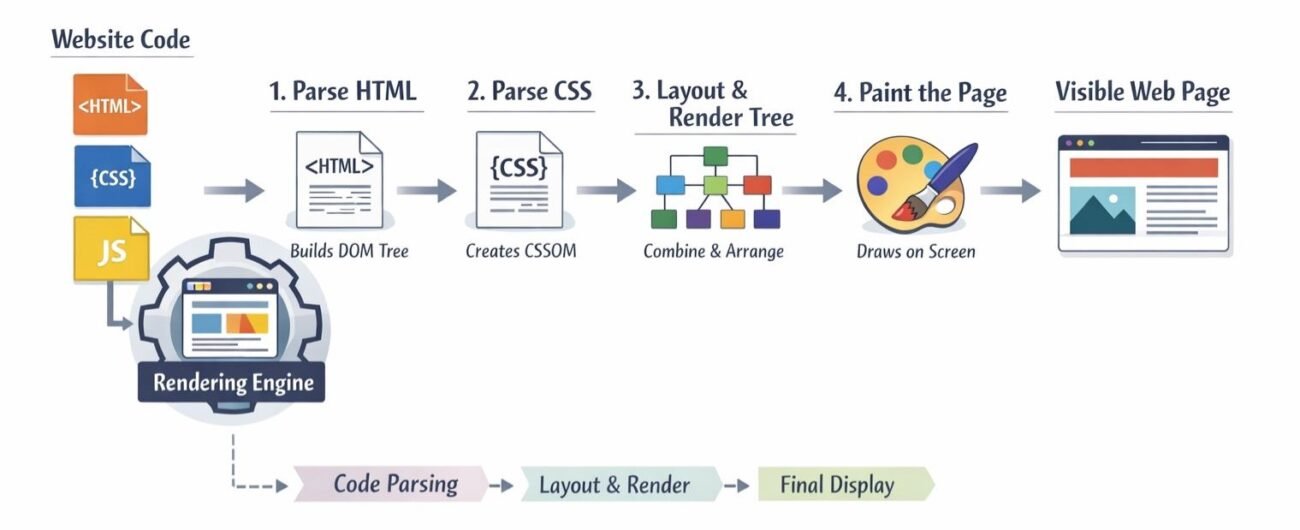
A Rendering Engine is the core component of a web browser that converts HTML, CSS, and JavaScript into a visual web page that users can see and interact with.
- Simple Example
Think of a rendering engine like a translator:
- Website code = one language
- Screen display = another language
- The rendering engine translates code into a visible webpage
- How Rendering Engines work?
Rendering engines mainly use C++ and C for speed, Rust for safety, JavaScript for webpage logic, and Assembly for extreme performance optimization.
- Why Java or Python Are NOT Used for Rendering Engines
Rendering engines must be extremely fast, memory-efficient, and close to the hardware. Java and Python are great languages—but not suitable for this job.
Python is not used for rendering engines because it is an interpreted language, which makes execution slower and less efficient for real-time rendering. It also consumes more memory and relies heavily on a runtime environment, offering limited low-level hardware control. Python is best suited for automation, AI, and scripting tasks—not for high-performance browser engines.
Java is not used for rendering engines because it runs on the JVM, which adds extra overhead and reduces performance. Its garbage collection can cause delays or momentary freezes, and it provides less direct control over memory and hardware. Java also has a slower startup compared to C++, making it better suited for enterprise applications rather than high-performance rendering engines.
- Code Parsing
Code parsing is the process of reading, analyzing, and understanding source code by breaking it into a structured format that a computer can work with.
Parsing: Checks and understands the structure of code OR Parsing = Checking grammar of a sentence OR Parsing = Understand & validate structure
Compiling: Converts code into machine-executable form OR Compiling = Translating the sentence into another language that a machine understands OR Compiling = Translate into executable form
Interpreting: Executes the code line-by-line OR Interpreting = Cooking the dish step-by-step while reading
Note
Parsing always comes first. Parsing is a subset of compiling. All compiled languages are parsed, but not all parsed code is compiled


I like this post, enjoyed this one appreciate it for posting.